Every day your website either earns trust or destroys it. There is no neutral. Visitors make a judgment about your business within seconds of landing on your site, and most of them will never tell you why they left.
If your phone is not ringing, your contact form is collecting dust, and your competitors seem to be getting all the leads, your website might be the problem. Here are five signs that your site is actively costing you customers.
1. Your Bounce Rate Is Above 60 Percent
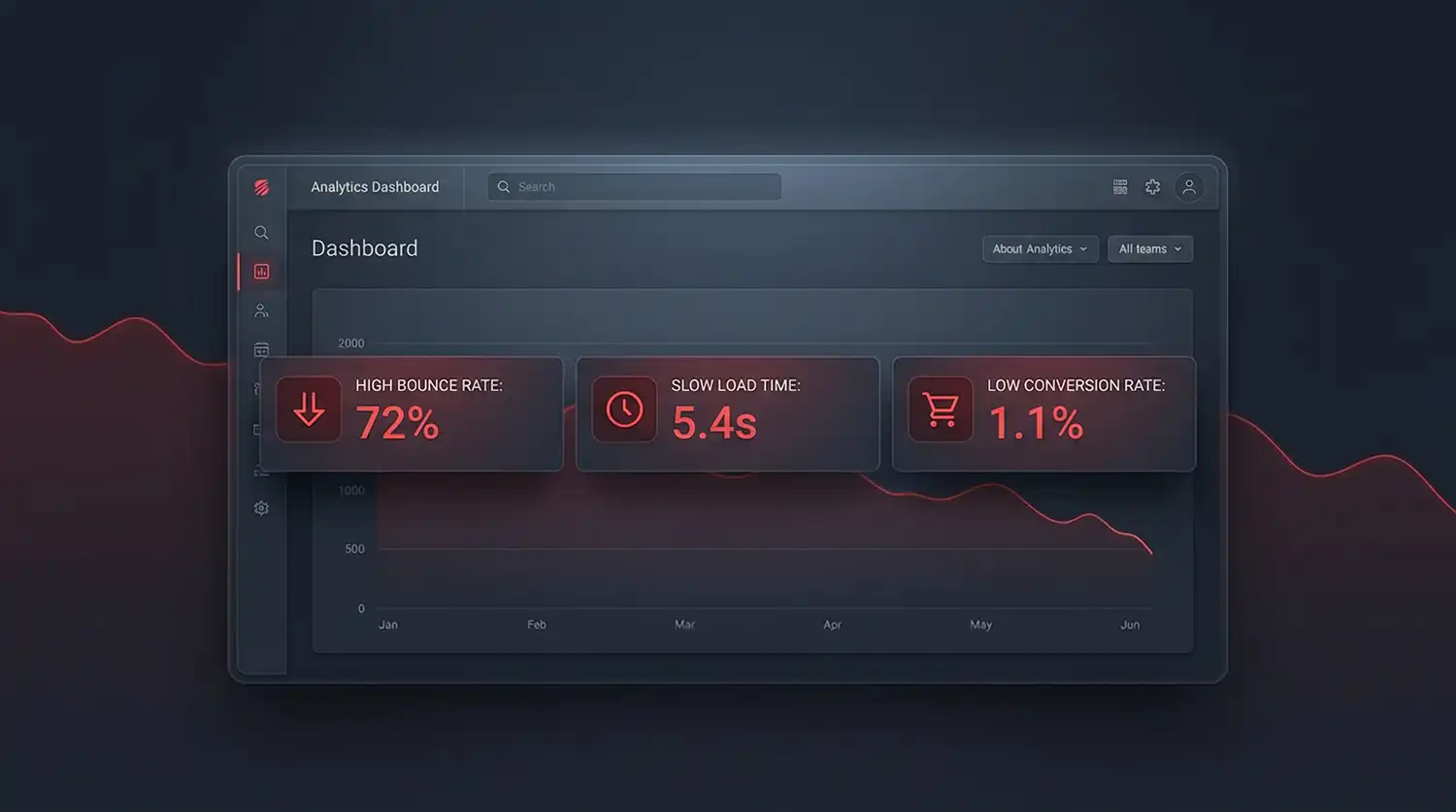
Bounce rate measures how many visitors leave your site after viewing only one page. A high bounce rate means people are arriving, deciding your site is not what they need, and leaving immediately.
Some bounce is normal. Not every visitor is a qualified lead. But if more than 60 percent of your traffic is bouncing, something is pushing people away before they even explore what you offer.
Common causes include slow load times that test people’s patience, a design that looks outdated or unprofessional, confusing navigation that makes it hard to find information, content that does not match what the visitor searched for, and pop-ups or intrusive elements that annoy visitors on arrival.
Check your bounce rate in Google Analytics under the engagement report. If it is consistently above 60 percent, your site has a first impression problem. The fix depends on the cause, but it almost always starts with faster load times, cleaner design, and clearer messaging above the fold.
2. Your Site Takes More Than 3 Seconds to Load
Speed is not a nice-to-have. It is a business requirement. Research consistently shows that conversion rates drop significantly for every additional second of load time. A site that takes 5 seconds to load can lose nearly half its visitors before they see a single word of content.
Google also uses page speed as a ranking factor. Slow sites rank lower, which means fewer people find you in the first place. The ones who do find you leave because the site feels sluggish.
You can test your speed right now at pagespeed.web.dev. Enter your URL and look at the mobile performance score. If it is below 50, speed is actively hurting your business.
Common speed problems include unoptimized images that are too large for web display, too many plugins or scripts running in the background, cheap shared hosting that cannot handle traffic, no caching to serve returning visitors faster, and bloated page builders that generate excessive code.
Some speed issues are quick fixes. Others require a more fundamental rebuild. Either way, ignoring speed means leaving money on the table every day.
3. You Have No Clear Call to Action
Visit your own website right now. On every page, ask yourself one question: what do I want the visitor to do next?
If the answer is not immediately obvious, you have a conversion problem. Every page on your site needs a clear, specific call to action. Call us. Fill out this form. Book a consultation. Get a quote. Request an estimate.
Many websites bury their contact information in the footer, hide the phone number, or rely on a single “Contact” link in the navigation. That is not enough. Visitors need to be guided toward the next step on every page they visit.
Effective calls to action are visually prominent and easy to find. They use action-oriented language that tells the visitor exactly what happens next. They appear multiple times throughout longer pages. They are consistent across the site so visitors always know how to reach you.
If your website looks nice but does not generate leads, missing or weak calls to action are almost always part of the problem. Adding a phone number to your header, placing contact buttons throughout your content, and making forms simple and short can dramatically increase conversions.
4. Your Website Is Not Mobile Friendly
More than 60 percent of web traffic comes from mobile devices. In local markets like Yuma, that number can be even higher because people search for services on their phones while they are out, at work, or sitting on the couch.
A website that works on desktop but fails on mobile is losing the majority of its potential customers.
Mobile problems include text that is too small to read without zooming, buttons and links that are too close together to tap accurately, horizontal scrolling that forces users to swipe sideways, images that overflow the screen or load slowly on cellular connections, and forms that are difficult to fill out on a small screen.
Open your website on your phone right now. Navigate to your most important service page. Try to call or submit a form. If any part of that experience is frustrating, your customers feel the same frustration. They just leave and choose a competitor instead.
Google uses mobile-first indexing, which means it primarily uses the mobile version of your site for ranking decisions. A poor mobile experience does not just lose visitors. It lowers your search rankings too.
5. Your Content Does Not Answer What People Are Searching
This is the most subtle problem and often the most expensive one. Your website might look good, load fast, and work on mobile, but if the content does not match what your ideal customers are actually searching for, you are invisible to them.
For example, if you are a roofing company in Yuma and your website says “We provide quality roofing solutions” but never mentions specific services like roof repair, roof replacement, tile roofing, or flat roof installation, Google has no reason to show your site when someone searches for those terms.
Effective website content is built around the actual phrases your customers type into Google. It answers their questions directly and thoroughly. It includes location-specific language that signals to search engines where you operate. It provides enough depth and detail to demonstrate expertise.
This is where SEO and content strategy become critical. Without keyword research and intentional content planning, your website is guessing at what matters. And guessing does not rank.
What to Do If Your Site Is Showing These Signs
If your website is showing one or two of these signs, targeted improvements might be enough. Speed optimization, adding calls to action, or updating your content can make a meaningful difference without a full rebuild.
If your site is showing three or more of these signs, the problems are usually structural. Patching individual issues on a fundamentally flawed site is like repainting a house with a cracked foundation. The deeper problems will keep surfacing.
In that case, a strategic rebuild gives you the opportunity to fix everything at once: design that converts, speed that meets Google’s standards, mobile experience that works, content that ranks, and calls to action that generate real leads.
Stop Losing Customers to a Broken Website
Your website is either your best salesperson or your biggest liability. If it is not generating calls, form submissions, and real business opportunities, something needs to change.
At GSL Design, we build websites specifically to solve these five problems. Fast, mobile-first, SEO-driven, and built to convert. No templates, no bloated page builders, just clean strategic builds for Yuma businesses that want real results.