
Electrician website design is the practice of building a website specifically structured to help electrical contractors attract local clients, display credentials, and convert visitors into booked jobs. Unlike a generic business site, a well-designed electrician website prioritizes trust signals, service clarity, and local search visibility from the first page load. The difference between a site that generates calls and one that sits idle usually comes down to a handful of deliberate design decisions. This article breaks down exactly what those decisions are and how you can apply them.
What is electrician website design and what makes it different
Electrician website design refers to the specialized approach of building a web presence around the specific needs of electrical contractors: licensing proof, service-area targeting, emergency contact access, and local SEO. A standard template site built for a retail store or consultant does not serve these needs. Electricians deal with high-stakes work where trust is the primary purchase driver, and the website must communicate that trust within seconds of a visitor arriving.
The core goals of website design for electricians are three: establish credibility fast, make it easy to contact you, and rank for local searches. Every design decision, from layout to page structure to color choice, should serve at least one of those goals. When a site fails to generate leads, it almost always fails on one of these three fronts.

Key features and trust signals every electrician site needs
Trust signals are the single most powerful conversion tool on an electrician website. License and insurance details placed in the header or hero section do far more work than the same details buried in a footer. Visitors decide within seconds whether to stay or leave, and a visible state license number answers the most important question immediately: “Is this person qualified?”
Here are the trust and design features that matter most:
- Your Arizona ROC license number displayed in the header or hero section, not the footer
- Star ratings and reviews on the homepage. A visible rating with a real review count reassures new visitors faster than any amount of marketing copy
- Tap-to-call phone number above the fold on mobile, especially for emergency service calls
- General liability insurance and qualifications listed clearly on the homepage or about page
- 3 to 5 recent Google reviews shown via a homepage widget or manual selection, which reduce visitor uncertainty at the moment it matters most
- Consistent fonts and colors that signal professionalism without distracting from the call to action
Pro Tip: Place your most important trust signals where a visitor’s eye lands first. On mobile, that means within the first screenful, before any scrolling. If a homeowner has to scroll to find your license number, most will not scroll.
How local SEO and service-area pages improve your site’s reach
Local SEO is the mechanism that connects your website to people searching “electrician near me” in your town. Service-area landing pages earn organic rankings for local-intent keywords even without a physical storefront, which means you can rank in multiple cities from a single location. This is one of the most underused advantages in electrician marketing.
Here is how to build a local SEO structure that works:
- Create a unique page for each service area. Each page should include the city name in the URL, title tag, and first paragraph. A page titled “Electrician in Fortuna Foothills” targets that city directly.
- Write original copy for each page. Duplicate content across service-area pages confuses Google and dilutes rankings. Write at least 300 words of unique, customer-focused content per page.
- Link service-area pages from your homepage and footer. Internal links signal importance to Google and help visitors find local information quickly.
- Keep your Google Business Profile consistent. Consistent service areas listed in your GBP, footer, and contact page influence Google’s local algorithm positively. A mismatch between your GBP and your website confuses both Google and potential clients.
- Connect local business directory listings to the matching service-area page, not just the homepage. This passes more relevant authority to the specific page you want to rank.
| Approach | Effect on local rankings |
|---|---|
| One generic “service area” page | Minimal ranking signal, low specificity |
| Unique page per city with original copy | Ranks for city-specific searches, higher qualified traffic |
| GBP and website service areas aligned | Stronger local algorithm signal, better map pack visibility |
Pro Tip: Service-area pages rank for “near me” searches even if you have no office in that city. A page targeting Somerton or San Luis can generate calls from those areas without you ever opening a second location.
How to organize your site’s pages for maximum conversions
A focused site structure guides visitors from first impression to a phone call or quote request. Clear calls to action repeated after key sections capture visitors at different decision stages, whether they are ready to book now or still comparing options. The goal is to remove every obstacle between a visitor and a conversion.
The pages your electrician site needs are straightforward:
- Homepage treated as an emergency landing page, with licensing, trust signals, and a clickable phone number above the fold
- Individual service pages for each core offering: rewiring, panel upgrades, electrical safety inspections, EV charger installation. Service-specific pages like “electrical panel upgrades” rank better than a single vague “services” page
- About page covering your experience, certifications, and compliance history
- Contact page with a tap-to-call number, a short quote request form, and an embedded map
- Service-area pages as described above
For emergency service, the phone number should be fixed in the mobile view so it stays visible as users scroll. A number placed above the fold on mobile captures urgent leads who will not wait to find your contact details. The majority of “electrician near me” searches happen on mobile devices, and those searchers often need help now.
Pro Tip: Dedicated pages for high-demand services like electrical safety inspections capture steady, predictable search volume from landlords and property managers. A standalone inspection page targets a specific audience with a specific need, which converts at a higher rate than a general services page.
Common mistakes that cost electricians leads
Most electrician websites lose visitors because of avoidable design and structure problems. In my experience, once a site takes more than about three seconds to load on a phone, a large share of visitors give up and call someone else. Speed is not optional.
The most common mistakes I see on electrician sites:
- No clear call to action. The site reads like a brochure with no instruction on what to do next.
- Phone number buried in the footer. If a visitor has to hunt for your number, they will call someone else.
- All services on one vague page. Combining rewiring, troubleshooting, and EV charger installation into a single paragraph reduces both search rankings and visitor clarity.
- Ignoring mobile usability. Tiny buttons, text that requires zooming, and slow load times all push mobile visitors away.
- Outdated or missing reviews. A site with no reviews or reviews from three years ago signals inactivity.
- Complex quote forms. A form asking for 10 fields before a visitor can request a quote will be abandoned. Keep it to name, phone, and job description.
You can review a broader list of contractor website mistakes that apply directly to electrician sites.
Pro Tip: Keep your homepage focused on one action: getting the visitor to call or submit a quote request. Every additional link or option you add to the homepage reduces the chance they take that primary action.
Practical steps to build or improve your electrician website
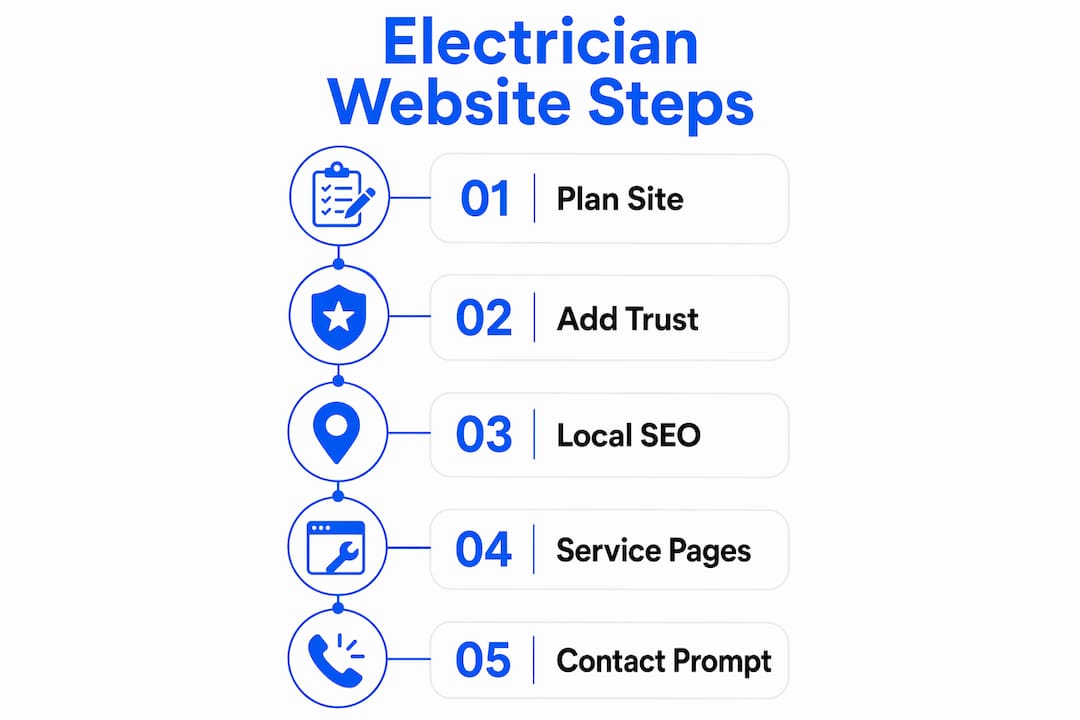
Building an effective electrician website does not require a large budget, but it does require a clear plan. A focused site with 4 to 5 pages outperforms a sprawling 20-page site that dilutes focus and confuses visitors. Start with the right structure and build from there.
- Map your site structure first. Plan a homepage, individual service pages, an about page, a contact page, and at least two service-area pages before you build anything.
- Choose a mobile-first design template or hire professional help. Most visitors arrive on a phone. A desktop-first design that is “adapted” for mobile rarely performs as well as one built mobile-first from the start.
- Set up and align your Google Business Profile. Add your service areas to GBP and mirror them on your website’s footer and contact page.
- Add local schema markup. Schema markup tells Google your business name, location, and service areas in a structured format it can read directly. Most WordPress plugins like Yoast SEO or Rank Math handle this without coding.
- Write customer-focused copy. Describe what you do in plain language, not trade jargon. “We replace old fuse boxes with modern breaker panels” is clearer than “panel upgrades and distribution board replacements.”
- Add a simple quote request form. Three fields maximum: name, phone number, and a brief description of the job.
- Update reviews and certifications regularly. A site that looks current signals an active, trustworthy business.
For a full breakdown of which pages to include, the essential website pages checklist covers the structure in detail.
Pro Tip: Investing upfront in a quality website reduces your dependence on third-party lead platforms like Angi, Thumbtack, or HomeAdvisor. Those platforms charge per lead and own the customer relationship. Your own site builds an asset you control.
Key takeaways
Electrician website design works when it combines visible trust signals, focused page structure, and local SEO targeting into a site built specifically for how electrical clients search and decide.
| Point | Details |
|---|---|
| Trust signals above the fold | Place licensing badges and reviews in the header or hero section, not the footer. |
| Service-area pages drive local leads | Unique pages per city rank for local searches without requiring a physical office there. |
| Mobile usability is non-negotiable | Slow-loading sites lose mobile visitors who are often ready to book immediately. |
| Focused structure outperforms complexity | A 4 to 5 page site with clear CTAs converts better than a sprawling, unfocused site. |
| GBP and website must align | Consistent service areas across Google Business Profile and your website improve local rankings. |
What I’ve learned building sites for trade contractors
After building websites for contractors across multiple trades, the pattern I see most often is this: electricians underestimate how much trust their website needs to establish before a visitor picks up the phone. A homeowner searching for an electrician is often dealing with a problem that feels urgent and potentially dangerous. They are not browsing casually. They want to know immediately that you are licensed, local, and reachable.
The sites that generate the most calls are not the most visually impressive ones. They are the ones where the phone number is impossible to miss, the license badge is front and center, and the service pages answer the exact question the visitor typed into Google. I’ve seen electricians with simple, clean five-page sites outperform competitors with elaborate sites that bury the contact information two scrolls down.
The other gap I see consistently is local SEO. Most electricians have a single homepage targeting their main city, and nothing else. Adding two or three service-area pages targeting nearby towns can open up a significant amount of additional search traffic from people who specifically want a local contractor. It is one of the highest-return improvements you can make to an existing site.
My approach with trade contractor sites is always the same: clear messaging at the top, fast path to contact, and local targeting built into the structure from the start. Simple sites, done right, win.
— Greg
Ready to build an electrician website that generates real leads?
If you are an electrician or electrical contractor looking to build a new site or fix one that is not performing, I build custom WordPress sites designed specifically to rank locally and convert visitors into calls and quote requests.

Every site I build through GSL Design’s website design service includes mobile-first design, local SEO structure, service-area pages, and clear calls to action built in from the start. I work with contractors in Yuma, AZ and the surrounding area, including the Foothills, Somerton, and San Luis. If you want a site that does more than look professional, get in touch for a consultation.
FAQ
What is electrician website design?
Electrician website design is the process of building a website tailored to the specific needs of electrical contractors, including trust signals, service-area targeting, and mobile-friendly contact options. The goal is to convert local search visitors into calls and booked jobs.
What pages does an electrician website need?
An electrician website needs a homepage, individual service pages, an about page, a contact page, and at least two service-area pages targeting nearby cities. This focused structure performs better than a large site with vague, overlapping content.
How does local SEO help an electrician website?
Local SEO connects your website to people searching for electricians in specific cities or neighborhoods. Service-area pages with unique content and a consistent Google Business Profile are the two most effective tools for improving local search rankings.
Where should trust signals appear on an electrician website?
Trust signals like licensing badges, star ratings, and insurance details should appear in the header or hero section of the homepage. Placing them in the footer or about page significantly reduces their impact on visitor confidence.
How many pages should an electrician website have?
A focused electrician website with 4 to 5 core pages outperforms larger sites that dilute attention and confuse visitors. Start with a homepage, service pages, an about page, a contact page, and expand with service-area pages as needed.