Every business owner eventually asks the same question: do I need a new website, or can I fix what I have?
The answer depends on what is actually wrong. Some problems are fixable with updates and optimization. Others run so deep that patching them wastes more money than starting fresh.
Here is how to tell the difference. If your website checks three or more of these boxes, a rebuild is almost certainly the smarter investment.
1. Your Website Is More Than 4 Years Old
Web standards move fast. A site built in 2021 or earlier is likely running on outdated technology, missing modern security protocols, and built before Google’s current ranking factors existed.
That does not mean every old site is bad. But if your site was built before Core Web Vitals became a ranking signal, before mobile-first indexing was standard, and before page experience became part of how Google evaluates your site, you are competing with a handicap.
A 4-year-old website is like a 4-year-old phone. It still works, but it is slower, less secure, and missing features that your competitors already have.
2. Your Site Looks Outdated
First impressions happen in about 50 milliseconds. Visitors decide whether your business looks credible before they read a single word.
Signs your site looks dated include large image sliders at the top of the page, small text with cramped spacing, stock photos that feel generic, cluttered layouts with too many elements competing for attention, and design trends from 5 or more years ago like heavy drop shadows, glossy buttons, or skeuomorphic design.
Your website is your 24/7 salesperson. If it looks like it was built in a different era, visitors assume your business operates the same way.
3. It Does Not Work Well on Phones
More than 60 percent of web traffic comes from mobile devices. If your site is hard to navigate, slow to load, or difficult to read on a phone, you are losing the majority of your potential customers before they even engage.
This goes beyond responsive design. A truly mobile-friendly site has tap targets that are easy to hit, text that is readable without zooming, forms that are simple to fill out on a small screen, and fast load times on cellular connections.
Open your website on your phone right now. Try to navigate to your contact page and submit a form. If that process is frustrating, your customers feel the same frustration. The difference is they leave and call your competitor instead.
4. You Cannot Update It Yourself
If you need to call your developer every time you want to change a phone number, add a blog post, or update a service description, your website is holding your business back.
A modern website should give you control over basic content changes. You should be able to add blog posts, update text and images, and manage basic page content without touching code or filing a support ticket.
If your current site runs on a proprietary platform, uses a builder you do not understand, or requires developer access for every small change, that dependency costs you time and money every month. And it means your site stays stale because updates feel like a hassle.
5. Your Website Does Not Show Up in Google
This is the most expensive problem on this list because it is invisible. Your site might look fine, function fine, and even load reasonably fast. But if it does not rank for the services you offer in your area, it is not generating leads.
Search “your service + your city” right now. For example, if you are a plumber in Yuma, search “plumber Yuma AZ.” If your website is not on the first page, you have an SEO problem.
Common causes include no keyword targeting in page titles or headings, thin content that does not give Google enough to work with, missing meta descriptions, no structured data or schema markup, no blog or fresh content, and poor internal linking between pages.
Sometimes these can be fixed on an existing site. But if the site was built without SEO in mind from the start, the structure itself is usually the problem. Retrofitting SEO onto a poorly built site is like remodeling a house with a bad foundation. At some point, rebuilding is cheaper.
Learn more about how we approach this in our website design services.
6. Your Site Is Slow
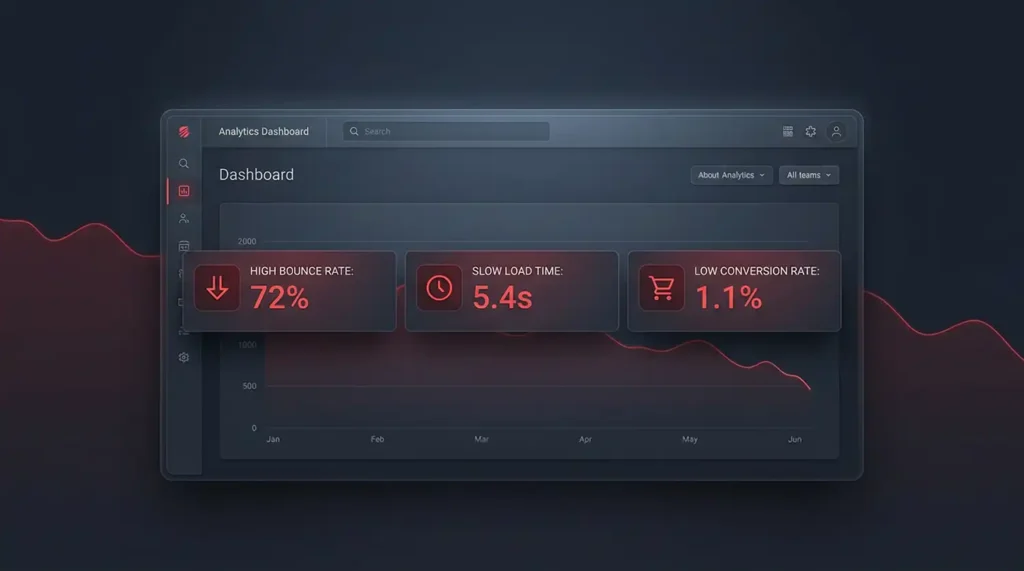
Page speed affects everything. Rankings, conversions, bounce rate, and user experience all suffer when your site takes too long to load.
Google expects your site to load its main content within 2.5 seconds. If your Largest Contentful Paint is above that, you are penalized in search results and losing visitors who will not wait.
Common speed killers include unoptimized images, too many plugins, bloated page builders, cheap shared hosting, no caching, and render-blocking JavaScript.
You can test your site speed right now at pagespeed.web.dev. If your mobile performance score is below 50, speed is actively hurting your business. Between 50 and 89, there is room for improvement. Above 90, you are in good shape.
Some speed issues are fixable without a rebuild. Others are faster and cheaper to rebuild from scratch on a clean codebase.
7. It Does Not Convert Visitors Into Leads
Your website has one job: turn visitors into customers. If people visit your site but do not call, fill out a form, or take the next step, something is broken in the conversion path.
Signs of a conversion problem include no clear call to action on every page, contact forms that are buried or hard to find, no phone number visible in the header, unclear messaging about what you do and who you serve, no social proof like testimonials or case studies, and too many options that overwhelm the visitor.
A website that gets traffic but no leads is worse than no website at all. It means people are finding you and deciding you are not the right choice.
Can I Fix My Current Site Instead?
Sometimes, yes. If your site is built on WordPress or another modern CMS, is less than 3 years old, has a clean codebase, and only has 1 or 2 of the problems listed above, targeted fixes might be the right call.
Situations where fixing makes sense include adding SEO to a well-built site, improving page speed through optimization, updating messaging without changing the design, and adding a blog to an otherwise solid structure.
Rebuilding makes more sense if your site has 3 or more of these problems, is bloated with plugins, built on proprietary systems, or was never structured for SEO from the beginning.
What a Modern Website Should Include in 2026
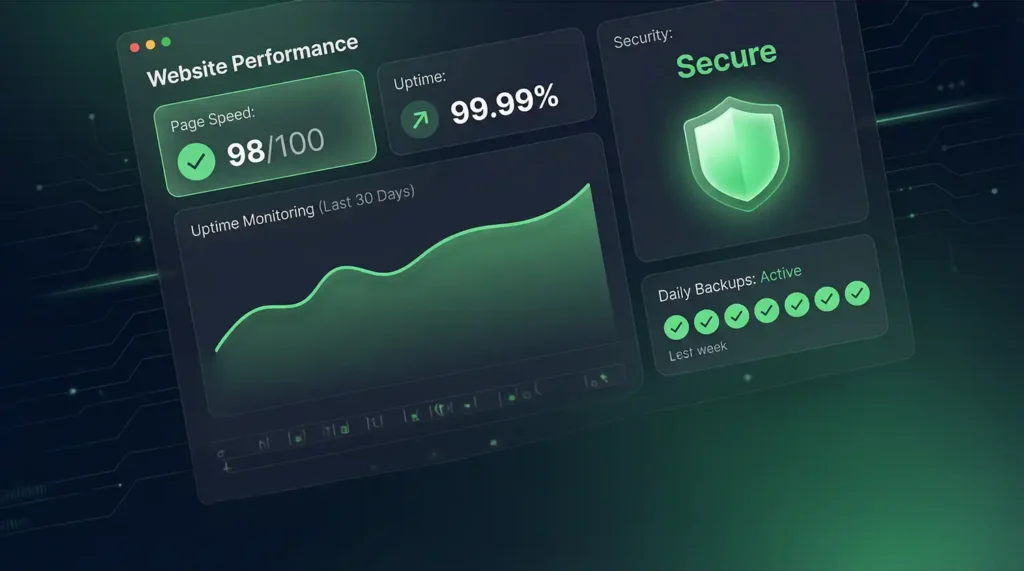
Performance. Fast load times on mobile and desktop with optimized code and caching.
SEO foundations. Keyword-targeted titles, meta descriptions, structured data, and search-friendly architecture.
Mobile-first design. Built for phones first, then scaled up.
Clear conversion paths. Every page should guide visitors toward action.
Content you can manage. A CMS that allows updates without developer dependency.
Ongoing maintenance. Security updates, backups, and monitoring.
Ready to Find Out?
If your website is checking multiple boxes on this list, you already know what needs to happen.
At GSL Design, we build websites that are fast, optimized for search, and engineered to convert visitors into customers. No templates. No bloated page builders. Just clean, strategic builds designed for Yuma businesses that want real growth.