SEO stands for search engine optimization. It is the process of making your website more visible in Google search results so that people who are looking for your services can find you.
That is the simple version. The more useful version is this: SEO is how you turn your website from a digital brochure into a lead generation tool that works for you 24 hours a day.
If you have ever wondered why some businesses show up on the first page of Google while others are buried on page five, the answer is almost always SEO.
How Google Decides Who Ranks
Google’s job is to show the most relevant, most useful result for any given search. When someone types “plumber Yuma AZ” into Google, the search engine evaluates hundreds of factors to decide which websites appear first.
The major factors fall into four categories.
Relevance means your content actually matches what the person searched for. If your website says “we offer quality services” but never mentions plumbing, pipe repair, or water heater installation, Google has no reason to show your site for plumbing searches.
Authority means other websites and sources consider your business credible. Google measures this through backlinks, reviews, citations, and your overall online presence. A business with dozens of positive reviews and links from local organizations signals more authority than one with no online footprint.
Technical quality means your website loads fast, works on mobile devices, has clean code, and is easy for Google to crawl and understand. A slow, broken, or poorly structured site will rank lower than a fast, clean, well-organized one.
User experience means visitors actually find your site useful. If people click your site in search results but immediately leave because it is confusing or unhelpful, Google interprets that as a negative signal and adjusts your ranking accordingly.
On-Page SEO: What You Control Directly
On-page SEO refers to optimizations you make directly on your website. These are the elements you have complete control over, and they form the foundation of any SEO strategy.
Title tags are the clickable headlines that appear in Google search results. Each page on your site should have a unique title tag that includes your primary keyword and location.
Meta descriptions are the short descriptions below the title tag in search results. They do not directly affect rankings, but they influence whether someone clicks your result.
Headings structure your content and signal to Google what each section is about. Your main heading (H1) should include your primary keyword. Subheadings (H2, H3) should organize the content logically and include related terms.
Content quality and depth matter enormously. Thin pages with a few sentences do not rank. Google favors comprehensive, helpful content that thoroughly answers the searcher’s question.
Internal links connect your pages together and help Google understand your site structure. Linking from your blog post about website costs to your services page helps both pages rank better.
Local SEO: Getting Found in Your Area
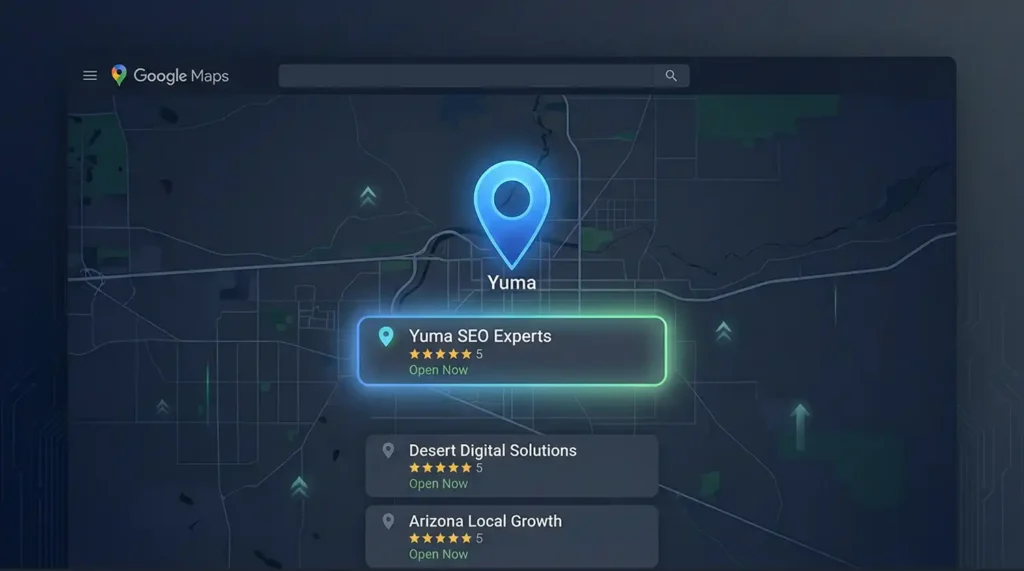
For businesses that serve a geographic area, local SEO is the most important subset of search optimization. Local SEO determines whether your business appears in Google Maps, the local pack, and location-based searches.
Local SEO includes optimizing your Google Business Profile, building consistent business citations across the web, earning genuine customer reviews, creating location-specific content on your website, and implementing local schema markup that helps Google understand where you operate.
For most small businesses in Yuma, local SEO delivers more immediate value than general SEO because you are competing in a smaller, more defined market.
Technical SEO: The Foundation
Technical SEO ensures your website can be properly crawled, indexed, and understood by search engines. Even the best content will not rank if Google cannot access and process your site correctly.
Key technical SEO elements include fast page load times, mobile responsiveness, a valid XML sitemap, structured data markup, secure HTTPS encryption, and clean URL structures.
This is one of the biggest differences between a cheap website and a strategically built one. Technical SEO is either built in from the start or it is not.
What SEO Is Not
SEO is not a one-time task. Rankings are competitive and constantly shifting. Consistent effort over time produces lasting results.
SEO is not about tricking Google. Keyword stuffing, buying backlinks, and manipulation tactics may produce short-term results but often lead to penalties.
SEO is not instant. Unlike paid advertising, SEO builds over time. Most businesses see meaningful results within three to six months of consistent effort.
SEO is not separate from your website. It should be built into the architecture from the beginning, not added as an afterthought.
Why SEO Matters for Your Business
Think about how you find businesses. When you need a service, you search Google. When you want to compare options, you search Google. When you need a phone number or read reviews, you search Google.
Your customers do the same thing. If your business is not visible in those searches, you are invisible to people actively looking for what you sell.
Paid advertising stops the moment you stop paying. SEO builds an asset. Every optimization and every piece of content contributes to long-term organic visibility that continues generating leads.
For small businesses with limited marketing budgets, SEO often delivers the strongest long-term return on investment.
Where to Start
If SEO feels overwhelming, start with the fundamentals. Make sure every page has a unique title tag that includes your service and location. Claim and complete your Google Business Profile. Ensure your site loads fast and works on mobile devices. Ask satisfied customers for reviews.
Those four steps alone put you ahead of most small businesses.
From there, the strategy becomes more advanced: content creation, link building, schema markup, and ongoing optimization. But the foundation is always the same. A well-built website, clear content, and consistent local signals.
At GSL Design, SEO is built into every site we create. Not as an add-on. Not as a separate service. It is part of the architecture from day one.