Choosing between WordPress and Shopify is one of the first decisions business owners face when building a website. Both platforms power millions of sites, and both have vocal advocates. But they solve different problems for different types of businesses.
Here is an honest comparison based on what actually matters: cost, control, SEO, scalability, and what makes sense for your specific situation.
The Core Difference
WordPress is an open-source content management system. You own the code, you choose your hosting, and you have full control over every aspect of your site. It powers roughly 40 percent of all websites on the internet, from small business sites to major publications.
Shopify is a hosted ecommerce platform. You pay a monthly subscription, and Shopify handles hosting, security, and the technical infrastructure. It is specifically designed for selling products online.
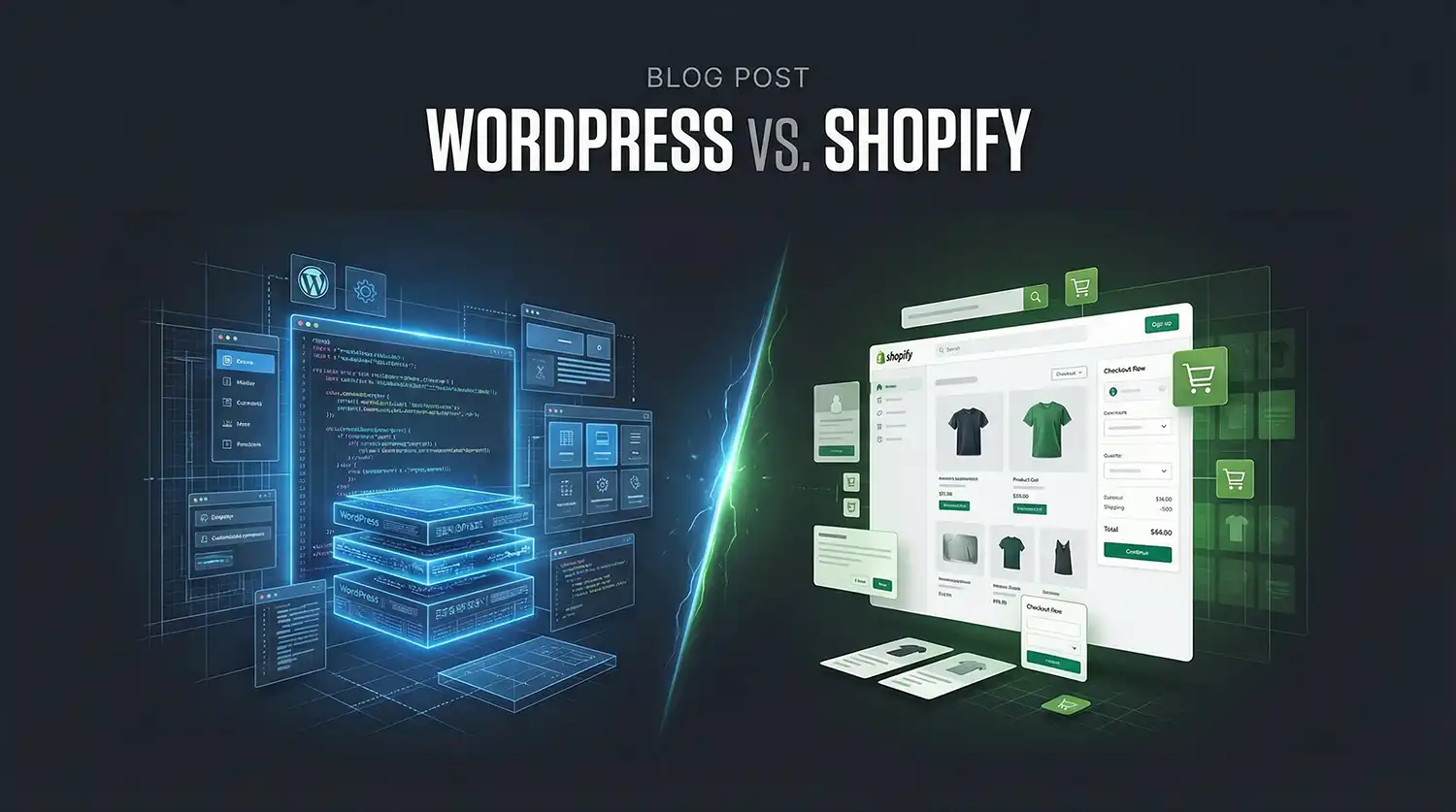
The fundamental tradeoff is control versus convenience. WordPress gives you more control and flexibility. Shopify gives you a simpler, more managed experience specifically for online stores.
Cost Comparison
WordPress costs include hosting ($10 to $50 per month for quality shared hosting, more for managed hosting), a domain name ($12 to $20 per year), a premium theme if needed ($50 to $200 one-time), and plugins for additional functionality. For ecommerce, WooCommerce is free but payment processing fees apply. Total ongoing cost for a typical small business WordPress site runs $20 to $60 per month plus the initial build investment.
Shopify costs include the monthly platform fee ($39 per month for Basic, $105 for Shopify, $399 for Advanced), a domain name, transaction fees if you do not use Shopify Payments, and premium theme and app costs. Most Shopify stores end up spending $50 to $150 per month on the platform plus apps.
WordPress has a lower ongoing cost floor. Shopify has a higher monthly cost but bundles more out of the box. Over three years, the total cost of ownership often favors WordPress for service businesses and Shopify for product-focused stores that need the ecommerce infrastructure from day one.
SEO Capabilities
This is where WordPress has a significant advantage. WordPress gives you full control over URL structures, meta data, schema markup, page speed optimization, internal linking architecture, and technical SEO at every level. You can optimize every element of every page without platform limitations.
Shopify has improved its SEO capabilities over the years, but you still hit limitations. URL structures include mandatory prefixes like “/collections/” and “/products/” that you cannot remove. Blog functionality is basic compared to WordPress. Technical SEO customization is limited by the platform’s architecture.
For businesses where organic search traffic is a primary growth channel, WordPress provides more flexibility and control over SEO. For businesses that rely primarily on paid ads and social media, Shopify’s SEO limitations may not matter as much.
Ecommerce Functionality
Shopify was built for ecommerce. Product management, inventory tracking, shipping calculations, tax handling, payment processing, and order fulfillment are all built into the core platform. The checkout experience is polished and optimized.
WordPress handles ecommerce through WooCommerce, a plugin that adds store functionality. WooCommerce is powerful and flexible, but it requires more setup and maintenance. You manage hosting performance, security, updates, and compatibility between WordPress, WooCommerce, your theme, and other plugins.
For businesses selling physical products as their primary activity, Shopify reduces complexity. For businesses that sell a few products alongside services or content, WooCommerce on WordPress provides more flexibility.
Ownership and Control
With WordPress, you own everything. Your code, your data, your content, and your hosting account are yours. You can move your site to any hosting provider, hire any developer, and make any modification you want.
With Shopify, you are renting space on their platform. Shopify controls the infrastructure and platform rules. If Shopify changes pricing or policies, you adapt or migrate.
For businesses that value long-term independence and full control, WordPress is the stronger choice. For businesses that prefer convenience over control, Shopify’s managed approach has appeal.
When WordPress Makes More Sense
- Your business is primarily service-based.
- Organic search and SEO are critical to growth.
- You need a highly custom design.
- You want full ownership and flexibility.
- Your site requires complex functionality beyond basic ecommerce.
- You plan to scale content marketing with a strong blog.
Most service-based businesses in Yuma are better served by WordPress because the focus is on generating leads, not processing transactions.
When Shopify Makes More Sense
- Your primary business model is selling physical products online.
- You want a fast path to a functioning store.
- You have a large product catalog.
- You do not want to manage technical infrastructure.
- Your growth strategy is focused on paid ads and social commerce.
A boutique, specialty product brand, or ecommerce-focused business shipping nationwide often benefits from Shopify’s purpose-built infrastructure.
Can You Use Both?
Some businesses use WordPress for their main website and Shopify for their store on a separate subdomain. This gives you WordPress’s SEO advantages while leveraging Shopify’s ecommerce strength.
This approach adds complexity but can make sense for content-heavy brands with strong ecommerce operations.
Making the Right Choice
The platform matters less than the strategy behind it. A well-built WordPress site will outperform a poorly built Shopify store, and vice versa.
At GSL Design, we build primarily on WordPress because most of our clients are service-based businesses that need strong SEO and full ownership. We also build ecommerce solutions on the platform that best fits the client’s needs.
If you are unsure which direction makes sense for your business, we can help you decide based on your goals and growth plans.