
You search “dentist near me” in Yuma and your competitor’s name pops up first. Again. It’s frustrating, especially when you know your practice delivers better care. The good news is that ranking higher on Google is not reserved for large clinics with massive marketing budgets. Simple, focused adjustments to your dental website can shift those results meaningfully. This article breaks down exactly what dental website SEO (Search Engine Optimization) involves, why it matters for Arizona practices specifically, and what steps you can take right now to attract more local patients and fill your appointment calendar.
Table of Contents
- Why local SEO matters for Arizona dental offices
- What does dental website SEO involve?
- Real-world results: How fast can dental SEO make a difference?
- Best practices for Arizona dental websites: From visibility to appointments
- What most Arizona dental offices miss about SEO success
- Bring world-class SEO to your Arizona dental practice
- Frequently asked questions
Key Takeaways
| Point | Details |
|---|---|
| Local SEO is critical | Optimizing for location-based search brings more nearby patients to your practice. |
| Focus on key website elements | Success comes from improving local, technical, content, and conversion factors together. |
| Results can be fast | Most dental practices notice a difference in leads within the first few months of SEO efforts. |
| Track what matters | Judge SEO by real business outcomes like appointments, not just visitor numbers. |
| Expert help accelerates success | Partnering with specialists speeds implementation and maximizes patient acquisition. |
Why local SEO matters for Arizona dental offices
Arizona is a fast-growing state. Phoenix, Tucson, Scottsdale, Mesa, and Yuma are all seeing population increases, which means more people are actively searching online for new dentists. When a potential patient types “dentist near me” or “family dentist Scottsdale” into Google, the practices that appear at the top of those results get the calls. The ones that don’t appear get ignored, regardless of how good their care actually is.
Local SEO (Search Engine Optimization) is the process of making your website and online presence visible to people searching within your geographic area. It is different from general SEO because it focuses on location-based signals that tell Google your practice is relevant to nearby searchers. The local SEO for Arizona businesses landscape is competitive, but it is also very winnable with the right approach.
Three elements drive local dental SEO more than anything else:
- Google Business Profile (GBP): This is the listing that appears in the map section of Google search results. Completing every field, adding photos, posting updates, and collecting reviews all improve your ranking in this critical section.
- Patient reviews: Google treats the volume and quality of your reviews as a trust signal. Practices with 50 or more four-star-and-above reviews consistently outrank those with fewer reviews, even when other factors are similar.
- Location-specific keywords: Phrases like “dentist Yuma,” “pediatric dentist Mesa,” or “emergency dentist Tucson” signal to Google exactly where you serve and what you offer.
“Local SEO guidance for Yuma dental clinics emphasizes Google Business Profile optimization and using location-specific service keywords such as ‘dentist near me’ and ‘dentist Yuma,’ combined with patient reviews, to improve local search rankings.”
When patients see your practice at the top of local results with strong reviews and a complete profile, they are far more likely to call or book an appointment. The trust is already partially built before they even visit your website. That is the power of local SEO done right. You can explore more through our local search services page to understand what a full local strategy looks like in practice.
What does dental website SEO involve?
Once we see why online visibility is vital, let’s clarify exactly what “SEO” means for a dental site. Many practice owners assume SEO is just about keywords. In reality, it covers four distinct areas, each of which contributes to your overall ranking and your ability to convert visitors into actual patients.

Here is a breakdown of the four main building blocks:
| SEO Area | Key Actions | Impact |
|---|---|---|
| Local | GBP optimization, reviews, location keywords | Drives nearby patient discovery |
| Technical | Site speed, HTTPS, mobile-friendliness | Improves crawlability and user experience |
| Content | Service pages, blog posts, local landing pages | Builds authority and keyword coverage |
| Conversion | Booking buttons, contact forms, call tracking | Turns visitors into actual appointments |
Let’s walk through each one in more detail.
-
Local SEO elements. Beyond your Google Business Profile, this includes making sure your practice name, address, and phone number (NAP) appear consistently across every online directory. Yelp, Healthgrades, Zocdoc, and local Arizona business listings all count. Inconsistent information confuses Google and hurts your ranking.
-
Technical SEO. Your website needs to load quickly, especially on mobile devices. Google uses mobile-first indexing, meaning it evaluates the mobile version of your site first when deciding where to rank you. A site that takes more than three seconds to load loses a significant portion of its visitors before they even see your services. HTTPS (a secure connection indicated by the padlock in the browser bar) is also a ranking factor and a trust signal for patients sharing personal information.
-
Content SEO. Each service you offer should have its own dedicated page. A single “services” page listing everything from cleanings to implants is not enough. Separate pages for cosmetic dentistry, orthodontics, emergency dental care, and pediatric dentistry each give you the opportunity to target specific keywords and rank for multiple searches. Adding a blog with answers to common patient questions, like “how often should I get a dental cleaning” or “what is the difference between a crown and a veneer,” builds authority over time.
-
Conversion optimization. This is where many dental websites fall short. You can rank on page one of Google and still lose patients if your website makes it hard to book an appointment. Clear calls-to-action, a visible phone number, an easy online booking form, and fast response to inquiries all directly affect how many visitors become patients. Our plain-English SEO guide goes deeper on how these elements work together.
Pro Tip: Set up call tracking on your website. Tools like CallRail let you see exactly how many phone calls your website generates each month. This data tells you whether your SEO is actually producing patients, not just visitors.
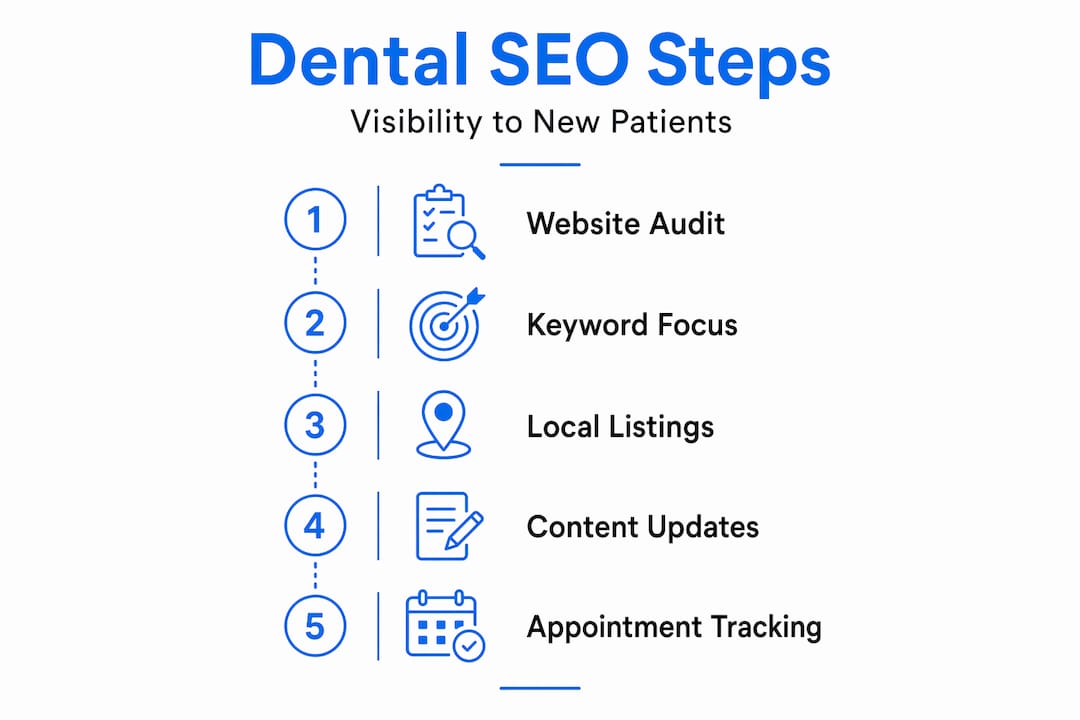
Dental SEO produces measurable gains within months when executed with a structured approach across all four of these areas. The key word is “structured.” Random changes rarely move the needle. A deliberate plan does. Check our SEO methodology tips for more on how to structure your approach.
Real-world results: How fast can dental SEO make a difference?
Concrete results motivate action, so let’s look at what is actually possible. One case study from a Miami dental practice shows organic traffic rising 40.5% in just 90 days, with organic sessions climbing to 7,400 per month. That kind of growth in under three months is not unusual when a practice starts from a low baseline and implements changes consistently.
Another example from the same source is even more striking. A dental office grew its monthly organic traffic from under 100 visitors to more than 1,500, and revenue climbed from $850,000 annually to over $3 million after sustained SEO efforts. These are real business outcomes, not just vanity metrics.
Here is a realistic timeline for what Arizona dental practices can expect:
| Timeframe | What typically happens |
|---|---|
| Month 1 | Technical fixes, GBP optimization, keyword research |
| Months 1 to 3 | Early ranking improvements for low-competition keywords |
| Months 3 to 6 | Noticeable traffic increases, more phone calls and form fills |
| Months 6 to 12 | Stronger rankings for competitive keywords, consistent lead flow |
| Year 2 and beyond | Compounding authority, lower cost per patient acquisition |
A few important points to keep in mind:
- Results vary based on your starting point. A practice with no existing SEO will often see faster early gains than one already ranking on page two.
- Competitive markets like Yuma require more sustained effort than smaller Arizona cities.
- Consistency matters more than intensity. Regular updates to your content and GBP outperform one-time bursts of activity.
- Algorithm changes happen. Google updates its ranking systems regularly, which is why ongoing attention to your SEO is necessary.
The lesson from these results is that SEO is not a lottery. It is a process with predictable outcomes when you follow the right steps. See more examples of how clients succeed online to understand what a realistic growth path looks like for a local practice.
Best practices for Arizona dental websites: From visibility to appointments
With a best practice list in hand, it is worth going through the specific actions that move Arizona dental practices from invisible to fully booked. These are not theoretical suggestions. They are the steps that consistently produce results across local healthcare markets.
-
Claim and fully optimize your Google Business Profile. Add your hours, services, photos of your office and staff, and a description that includes your city and specialty. Post updates at least twice a month. Respond to every review, positive or negative.
-
Build dedicated service pages with local keywords. Each major service should have its own page. Write at least 500 words per page and include the city or neighborhood you serve naturally within the content. Avoid keyword stuffing, which means forcing keywords in awkwardly. Write for your patient first, then optimize.
-
Make your website fast and mobile-friendly. Use Google’s free PageSpeed Insights tool to check your site’s load time. Aim for a score above 80 on mobile. Compress images, use a reliable hosting provider, and avoid heavy plugins or scripts that slow your site down.
-
Add a clear booking path on every page. Your phone number should appear in the header of every page. An “Book an appointment” button should be visible without scrolling. Make it as easy as possible for a motivated patient to take action.
-
Collect reviews systematically. After each appointment, send a follow-up text or email with a direct link to your Google review page. Most patients are willing to leave a review when asked directly and given an easy path to do so.
Pro Tip: Create a separate landing page for each city or neighborhood you serve, even if your office is in one location. A page titled “Family dentist serving Chandler and Gilbert” can rank for searches in those areas and bring in patients from a wider radius.
“Dental SEO effectiveness is typically judged not just by rankings but by conversions such as calls and bookings, since the goal is patient acquisition rather than traffic alone.”
This is the mindset shift that separates practices that grow from those that stagnate. Explore our web design SEO tips and our guide on conversion-focused SEO design to see how design and SEO work together to drive actual bookings.
What most Arizona dental offices miss about SEO success
Here is an uncomfortable truth that most agencies will not tell you: ranking on page one of Google is not a business outcome. It is a means to one.
We have seen dental practices celebrate a jump to the number-one spot for “dentist Yuma” while their actual new patient numbers barely moved. Why? Because their website had no clear booking path, their phone number was buried in the footer, and their online booking system was broken on mobile. The traffic arrived and then left.
The practices that grow consistently treat their website as part of their patient intake pipeline. They track calls. They monitor form submissions. They follow up with inquiries within minutes, not hours. They know exactly how many new patients came from organic search last month versus paid ads versus referrals.
Most agencies measure success by rankings and traffic. Top-performing dental practices measure success by appointments booked and revenue generated. Those are very different scoreboards.
The other thing most offices miss is the compounding effect of content. A blog post written today about “what to expect from your first dental implant consultation in Tucson” may generate one or two visitors in its first week. In 18 months, it could be generating 200 visits per month from people actively researching that procedure. SEO rewards patience and consistency in ways that paid advertising simply cannot replicate.
Treat your website as a living part of your practice, not a static brochure. Update it. Add to it. Monitor it. Connect it to your conversion-first strategies so every visit has a clear path to becoming a patient.
Bring world-class SEO to your Arizona dental practice
If you are ready to stop guessing and start seeing real results, working with a team that understands both local SEO and conversion-focused web design makes a significant difference. At GSL Design, we build websites and SEO strategies specifically designed to bring local patients through your door, not just visitors to your page.
Our Yuma SEO services are built for Arizona businesses that need to rank locally and convert that traffic into real leads. We pair that with website design specialists who understand how structure, speed, and clarity affect patient trust and booking rates. And if you want to start with a self-audit, our SEO-boosting website tips give you a practical starting point. Reach out to GSL Design and let’s build a strategy that fills your schedule, not just your analytics dashboard.
Frequently asked questions
How long does it take for dental SEO to show results?
Most dental practices see measurable SEO improvement within 1 to 3 months with a structured plan, though competitive markets may take longer. Dental SEO produces measurable gains within months when the approach covers local, technical, content, and conversion elements together.
Is Google Business Profile really essential for Arizona dental offices?
Yes, it is one of the highest-impact steps you can take. Local SEO guidance for Yuma dental clinics consistently emphasizes Google Business Profile optimization as a primary driver of local search visibility and patient inquiries.
What keywords should my dental website use for Arizona SEO?
Focus on location-specific phrases that match what patients actually type, such as “dentist Yuma” or “pediatric dentist Scottsdale.” Using location-specific service keywords in your page content, titles, and GBP description directly improves your chances of appearing in nearby searches.
Does more website traffic always mean more patients?
Not automatically. A high-traffic website with a poor booking experience will still lose patients. Dental SEO effectiveness is measured by conversions, meaning actual calls, form submissions, and appointments, not visitor counts alone.
Should I hire a professional for dental SEO or handle it myself?
A professional can implement proven strategies faster and avoid costly mistakes, but basic improvements like optimizing your Google Business Profile and adding location keywords are achievable on your own if you commit the time and follow a structured plan.