
Your homepage has a tough job.
In just a few seconds, it has to tell visitors who you are, what you do, why they should trust you, and what they should do next. If your copy is vague, confusing, or buried under generic marketing language, people leave. And for small businesses and service companies in Yuma, Arizona, that can mean missed calls, lost quote requests, and customers choosing a competitor instead.
A high-performing homepage should quickly answer four simple questions: who you serve, what result you provide, why you’re different, and how someone can take the next step. This guide walks you through how to write homepage copy that is clear, helpful, engaging, and built to turn visitors into real customers.
Table of Contents
- Homepage copy essentials: What every small business homepage needs
- Gather your proof before you write
- Step-by-step homepage copy framework
- Common homepage copy mistakes and quick fixes
- How to measure if your homepage copy is working
- What local business homepage copy needs to do differently
- Need help improving your homepage?
- Frequently asked questions
Key Takeaways
| Point | Why it matters |
|---|---|
| Clarity wins | Your homepage should immediately explain who you help, what you do, why you’re different, and what action to take next. |
| Lead with outcomes | Customers care less about your process and more about the result they get from working with you. |
| Use proof early | Reviews, project photos, certifications, local experience, and real results help visitors trust you faster. |
| Write for skimmers | Most visitors scan before they read. Strong headings, short sections, and clear CTAs keep them moving. |
| Track what changes | Measure calls, form submissions, click-throughs, and engagement after updating your homepage copy. |
Homepage copy essentials: What every small business homepage needs
Most small business owners write their homepage like they’re introducing themselves at a networking event. They talk about when the business started, list a few services, and maybe add a tagline that sounds nice.
But website visitors are not casually browsing your biography. They usually show up with a problem.
Their AC stopped working. Their pool looks cloudy. Their website is not generating leads. Their truck needs repairs. Their project is overdue. They want to know one thing: Can this business help me?
That means your homepage copy needs to get clear fast.
A strong homepage should answer these four questions almost immediately:
- Who do you serve? Be specific. “Homeowners in Yuma and the Foothills” is stronger than “customers in your area.”
- What problem do you solve? Speak to the real issue your customer is dealing with.
- Why should they choose you? Mention the proof that matters most: reviews, experience, licensing, speed, guarantees, or local knowledge.
- What should they do next? Give them one obvious action, such as “Call now,” “Get a free quote,” or “Schedule your service.”
Clarity beats cleverness every time. A creative tagline might make you feel good, but if it makes visitors think too hard, it is hurting your results.
“The goal of your homepage is not to impress visitors. It is to help them quickly understand why you are the right choice.”
Here’s a simple comparison:
| Weak homepage copy | Stronger homepage copy |
|---|---|
| “Welcome to our website.” | “Reliable pool service for Yuma homeowners.” |
| “We are a full-service solutions provider.” | “We repair AC systems in Yuma homes, often the same day.” |
| “Quality you can trust.” | “Licensed, insured, and serving Yuma since 2008.” |
| “Learn more about our services.” | “Get your free estimate today.” |
Building high-performing Yuma websites starts with getting this message right before worrying about colors, animations, or fancy layouts.
Pro tip: Put your phone number, primary service, service area, and main call-to-action near the top of the page. If visitors have to hunt for basic information, many will leave before they ever contact you.
Gather your proof before you write
Before you start writing homepage copy, collect the details that make your business believable. This is where many small businesses go wrong. They sit down to write and end up with generic phrases like “great customer service,” “high-quality work,” and “trusted professionals.”
Those phrases are not bad, but they are not enough.
Your homepage should feel like it could only belong to your business, in your market, serving your customers.

Visitors need immediate problem-to-solution clarity and trust signals early. That means your proof should not be an afterthought buried at the bottom of the page. It should shape the copy from the beginning.
Start by gathering:
- Your best customer reviews: Look for reviews that mention specific results, fast service, professionalism, or local trust.
- Your strongest numbers: Years in business, number of customers served, completed projects, review count, or average rating.
- Your service area: Mention Yuma, the Foothills, Somerton, San Luis, Wellton, or other areas you actually serve.
- Your licenses and credentials: ROC license numbers, insurance, certifications, manufacturer approvals, or industry training.
- Project photos: Real photos almost always outperform generic stock images, especially for local service companies.
- Your most common customer problem: The thing people call you about most is often the best starting point for your headline.
- Your most valuable offer: Lead with the service or result your customers care about most.
You can organize your proof like this:
| Service | Proof | Customer outcome |
|---|---|---|
| HVAC repair | 15 years serving Yuma, licensed ROC contractor | A cooler, more comfortable home |
| Drain cleaning | 200+ five-star reviews | Clear drains without repeat clogs |
| Landscaping | Local desert plant expertise | A low-water yard that looks good year-round |
For local businesses, details matter. Yuma has a very specific environment: extreme summer heat, dust, hard water, agriculture, military families, snowbirds, and tight-knit neighborhoods. When your copy reflects that reality, it feels more trustworthy.
For example, “We know Yuma summers” says more than “We provide quality HVAC service.” One sounds local. The other sounds like every contractor website on the internet.
You can see this kind of local positioning in our local project examples.
Best types of social proof for local business homepages
- Google review rating with the number of reviews shown
- Short testimonials from local customers
- Photos of real projects or completed work
- Logos of brands, suppliers, or organizations you work with
- Local awards, media mentions, or community involvement
- Specific numbers, such as “500+ Yuma homes served”
Step-by-step homepage copy framework
Once you have your proof, writing becomes much easier. Instead of staring at a blank page, use a simple homepage copy framework.
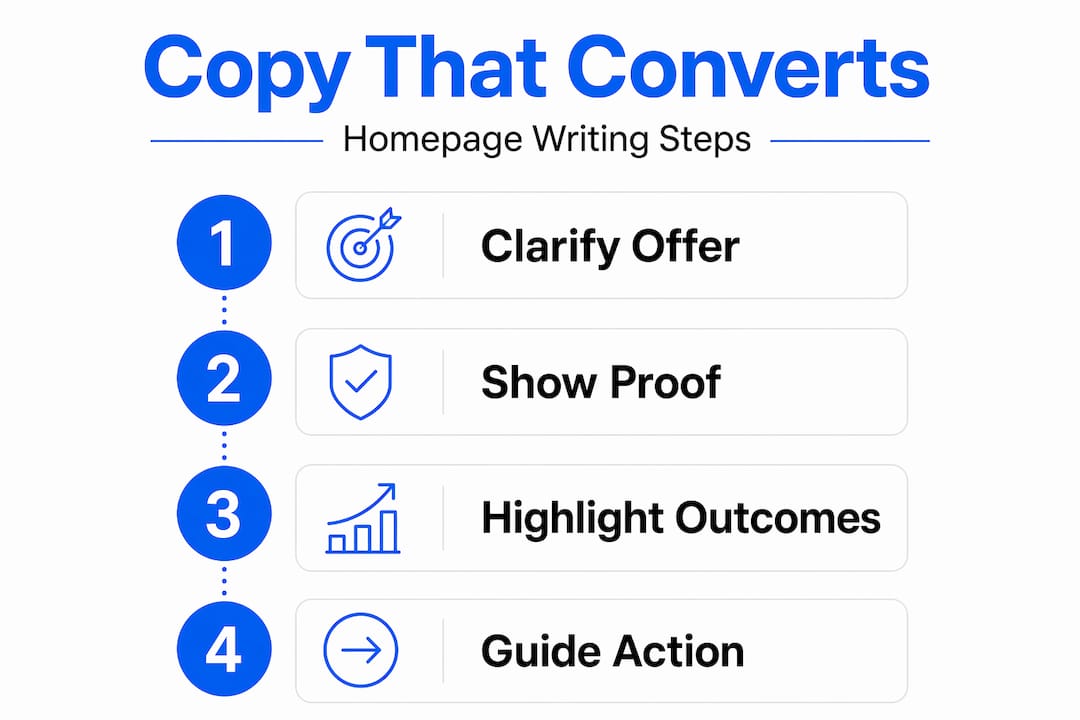
Homepage copywriting guidance often recommends an outcome-focused headline, a short value statement, and a clear CTA. That structure works because it matches how people actually scan websites.
1. Write a headline that says what you do and why it matters
Your headline should not be mysterious. It should quickly communicate the main result you provide.
Instead of:
“Creating comfort through innovative solutions.”
Try:
“Fast AC Repair for Yuma Homes and Businesses.”
A strong homepage headline usually includes one or more of the following:
- The service you provide
- The location you serve
- The problem you solve
- The result the customer wants
- A trust factor, such as “licensed,” “local,” or “same-day”
Examples:
- “Reliable Pool Service for Yuma Homeowners”
- “Custom Websites That Help Yuma Businesses Get More Leads”
- “Same-Day Plumbing Help Across Yuma County”
- “Premium Auto Detailing, Ceramic Coating, and Tint in Yuma”
2. Add a subheading that explains who you help
Your subheading gives visitors the extra context they need after reading the headline. Keep it short, specific, and customer-focused.
Example:
“We help local homeowners and businesses solve urgent plumbing problems with fast response times, honest pricing, and experienced technicians.”
Notice how that sentence explains who the business helps, what they do, and why the customer should care.
3. Use one primary call-to-action
Your homepage should have one main action you want visitors to take. Do not make them choose between five equally important buttons.
Good CTA examples include:
- Call Now
- Get a Free Quote
- Schedule Your Service
- Book an Appointment
- Request an Estimate
Weak CTA examples include:
- Submit
- Learn More
- Click Here
- Get Started
“Get Started” can work in some industries, but for local service businesses, direct CTAs usually perform better. A homeowner with a broken AC does not want to “start a journey.” They want help.
4. Add trust immediately
Right under your hero section, add one strong proof statement.
Examples:
- “Rated 4.9 stars by 300+ local customers.”
- “Licensed, insured, and serving Yuma County since 2012.”
- “Trusted by homeowners across Yuma, the Foothills, Somerton, and San Luis.”
- “Family-owned, locally operated, and backed by real customer reviews.”
This helps visitors feel safer taking the next step.
5. Describe services by outcome, not just category
Many homepages list services like this:
- Drain cleaning
- Hydro jetting
- Sewer repair
- Camera inspections
That list is useful, but it does not fully explain the value.
A stronger version would say:
- Clear stubborn clogs: Drain cleaning and hydro jetting for backed-up sinks, showers, and sewer lines.
- Find the problem fast: Camera inspections that help identify cracks, roots, and hidden blockages.
- Protect your property: Sewer repair solutions designed to prevent bigger plumbing emergencies.
Now the services are tied to outcomes the customer understands.
6. Repeat the CTA near the bottom
Some visitors are ready to call after reading the headline. Others need to read your services, reviews, and process first. Give both types of visitors a clear next step.
Near the bottom of the homepage, repeat the offer with a strong CTA:
“Ready to get your project started? Contact us today for a free quote.”
Homepage copy should be structured for skimming with the most important information first. Most visitors will scan your headline, subheading, buttons, service headings, and reviews before deciding whether to contact you.
Pro tip: Link each core service to its own dedicated page instead of trying to explain everything on the homepage. This improves the user experience and helps search engines better understand what each page is about. Learn more about building your business website the right way from the start.
For SEO-boosting homepage tips, use natural search phrases your customers would actually type, such as “Yuma AC repair,” “Yuma pool service,” “Yuma plumber,” or “website design in Yuma.” Do not force keywords awkwardly. Clear copy should still sound human.
Common homepage copy mistakes and quick fixes
Even good businesses often have weak homepage copy. The problem usually is not the quality of the business. It is that the website does not explain the value clearly enough.
Here are the most common homepage copy mistakes and how to fix them.
Mistake 1: The headline is too vague
Weak: “Welcome to ABC Services.”
Better: “Reliable Plumbing Repairs for Yuma Homes and Businesses.”
Your headline should tell visitors what you do, where you do it, and why they should keep reading.
Mistake 2: There is no clear CTA above the fold
If someone has to scroll to find your phone number or quote button, you are creating unnecessary friction.
Fix: Add a visible button near the top of the page. On mobile, make the phone number easy to tap.
Mistake 3: The copy talks too much about the business
Your story matters, but the customer’s problem matters first.
Weak: “We started our company because we are passionate about quality service.”
Better: “When your AC stops working in the Yuma heat, our team responds fast with reliable repair service.”
Make the customer the center of the message.
Mistake 4: Services are listed without context
A plain service list is better than nothing, but it does not show value.
Fix: Pair each service with a result, benefit, or problem solved.
Mistake 5: The page has too many competing CTAs
“Call us,” “Email us,” “Follow us,” “Download this,” “Read more,” and “Subscribe” should not all compete for attention in the same section.
Fix: Choose one primary CTA and make it the obvious next step.
Mistake 6: There are no local trust signals
Generic copy could describe any business in any city. Local copy builds confidence.
Fix: Mention your real service area, local experience, neighborhood examples, reviews, project photos, or community connections.
Mistake 7: Proof is buried too low
If your best reviews, project photos, or credentials are hiding near the bottom of the page, many visitors will never see them.
Fix: Place your strongest trust signal near the top of the homepage.
“Friction zones are the spots where visitors get confused, uncertain, or bored. Removing those friction points is one of the fastest ways to improve website results.”
If your homepage includes multiple services, make the page easy to navigate. Group related services, explain the outcome of each one, and link to dedicated service pages. Cramming everything into one giant block of text overwhelms visitors and weakens your SEO.
This is one of the reasons generic website templates often fail local businesses. They are built to look acceptable for everyone, which means they are rarely optimized for your specific customers. See why template pitfalls can quietly cost you customers.
How to measure if your homepage copy is working
Once your updated homepage copy is live, do not just hope it performs better. Track it.
Case studies show measurable gains when homepage copy clearly explains the value proposition, removes objections, and makes the next step easier. The key is measuring the right things before and after the rewrite.
Here are the numbers worth watching:
- Phone call clicks: Track how many mobile visitors tap your phone number.
- Form submissions: Monitor quote requests, appointment forms, contact forms, and booking requests.
- Button clicks: See which CTAs people actually use.
- Bounce rate: A high bounce rate can mean visitors are not finding what they expected.
- Time on page: If people leave quickly, your headline, offer, or layout may need work.
- Scroll depth: If visitors never reach your services or testimonials, those sections may need to move higher.
Use a simple before-and-after table:
| Metric | Before rewrite | After rewrite | Change |
|---|---|---|---|
| Weekly call clicks | 8 | 19 | +138% |
| Monthly form submissions | 4 | 11 | +175% |
| Bounce rate | 74% | 58% | Improved |
| Average time on page | 0:28 | 1:14 | Improved |
Simple homepage tests to run
- Test a clearer headline that includes your service and location.
- Change a vague button like “Submit” to “Get My Free Quote.”
- Add a strong testimonial near the top of the page.
- Replace a stock photo with a real photo of your team, truck, shop, or completed work.
- Move your most popular service higher on the page.
- Add a short FAQ section to answer common objections.
Revisit your homepage copy at least twice a year. Your services, pricing, customer questions, and local competition change over time. Your homepage should reflect where your business is now, not where it was two years ago.
Check our client growth results to see how better strategy, clearer messaging, and ongoing improvements can help businesses win more leads online.
What local business homepage copy needs to do differently
A lot of homepage copywriting advice is written for national brands, software companies, or large e-commerce stores. Some of that advice is useful, but local service businesses need a different approach.
Local customers are not only comparing offers. They are deciding whether they trust you.
In a market like Yuma, trust is personal. People want to know you understand the area, the weather, the neighborhoods, the urgency, and the expectations of local customers.
A polished website helps, but if the copy feels too corporate or too generic, it can create distance. Local customers usually respond better to clear, direct, helpful language.
For example:
| Corporate-sounding copy | Local, customer-focused copy |
|---|---|
| “Innovative comfort solutions for modern living.” | “AC repair that helps keep your Yuma home cool when temperatures climb.” |
| “Start your transformation today.” | “Call today for a free estimate.” |
| “Experience next-level service.” | “Fast, friendly service from a local team you can actually reach.” |
For local businesses, plain-language CTAs often outperform clever ones. “Call today for a free quote” is not flashy, but it is clear. And clarity converts.
We saw this clearly with a local plumbing company whose homepage was full of industry language and brand messaging that did not connect with homeowners dealing with urgent plumbing issues. When the copy shifted toward direct, problem-focused language, the page became much more useful for real customers. You can see that approach in our local homepage case study.
The uncomfortable truth is that many small business homepages are written for the business owner, not the customer. They focus on what the owner wants to say instead of what the visitor needs to understand.
The best homepage copy flips that around.
It answers the customer’s question first:
“Can you help me, can I trust you, and what do I do next?”
Need help improving your homepage?
Writing homepage copy that actually converts takes more than filling in a few sections. It requires understanding your customers, your market, your services, your proof, and the specific action you want visitors to take.
If your homepage looks good but is not generating enough calls, quote requests, or leads, the copy may be one of the biggest opportunities for improvement.

At GSL Design, we help Yuma-area small businesses and service companies build websites that do more than look professional. We create websites designed to attract the right visitors, explain your value clearly, and turn traffic into real leads.
Our website design services include conversion-focused copywriting built around your market, your services, and your customers. We also offer local SEO strategies to help your business get found by more people in Yuma, the Foothills, and surrounding communities.
Whether you need a full website build, a homepage refresh, or a better strategy for turning visitors into customers, we can help you create a website that works harder for your business.
Frequently asked questions
What makes homepage copy effective for small businesses?
Effective homepage copy quickly explains who you help, what problem you solve, why visitors should trust you, and what action they should take next. The best copy is clear, specific, and focused on the customer’s desired outcome.
How long should my homepage copy be?
Your homepage should be long enough to answer the visitor’s key questions, but short enough to stay easy to scan. For most small businesses, that means clear sections for the hero message, services, proof, process, testimonials, FAQs, and a final call-to-action.
Should I use the same homepage copy if I offer multiple services?
Your homepage can introduce multiple services, but each service should be clearly separated and linked to a dedicated service page. This keeps the homepage easier to understand and gives each service a better chance to rank in search results.
How do I know if my new homepage copy is working?
Track phone call clicks, quote requests, form submissions, button clicks, time on page, and bounce rate. Compare your results before and after the rewrite to see if the new copy is helping more visitors take action.